Welcome!
Let us help you improve your search engine rankings,capture
traffic, monetize, and make your blog look awesome!

Link Roundup - 20 Essential Ways To Increase Blog Traffic

You don't want to miss this!

Getting Traffic 107 - The Mega SEO Resource Guide

Can you handle it?

Follow us on your favorite networking site!

Stay up to date with all the latest Blogging tips and tricks!

Building Your Blog 500 - Guest Posts On Your Blog

Are Guest Posts For You?

Showing posts with label content is king. Show all posts

Monday, September 17, 2012

Building Your Blog 205 - What To Do When You Run Out Of Ideas

I came across a great post today about coming up with new things to blog about when you get stuck or run out of ideas, and I really wanted to share it with you.  Check out 11 Fail-Proof Blog Post Ideas.

You can also check out this slideshow about What to blog about when you've run out of ideas HERE.

I'd also like to add the following idea generation techniques to the list:

1) Read other blogs in your niche to see what they're writing about.  Of course you should never plagiarize, but reading other blogs might spark an idea you haven't thought about before, or you may be able to expand on an idea another blogger has already written about, but perhaps hasn't covered as thoroughly as they could have.

2) Write about any relevant news in your niche.  Back to the time tested dog blog: If you're writing a blog about dogs, then go to Yahoo News or MSN news and search out news about dogs.  You might find that you enjoy writing about that latest dog show, the latest dog food recall, or about that dog with a fifth leg that was just born.  It will be interesting to readers, and it's a great fail-safe for when you've run out of ideas.

Don't forget to check out our other helpful post on this topic HERE.

What do you think?  Are there techniques you use when you run out of ideas?  Shout them out in a comment below to help others who need a little inspiration!


Thursday, May 17, 2012

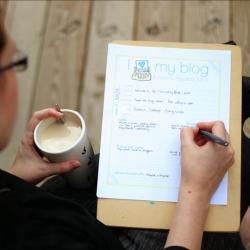
Building Your Blog 101 - Planning Your Blog

I'm assuming you're here because you need some help planning out your new blog, or perhaps looking for a new way to get more organized with a well established blog.  A lot of this has to do with time management, which you can view a post on HERE.  In this particular post though we're going to steer clear of time management and focus more on three things:

1) Planning a posting schedule
2) Planning content
3) Planning goals for the blog and meeting them


1) Planning a posting schedule

I came across an interesting article the other day on The Dainty Squid.  This blogger came up with an ingenious way to organize and keep track of when she'll be posting certain articles.  Check out the article:  The Dainty Squid: Blog Planning.

Posting regularly is important for a successful blog.  Sometimes I'll post two or three articles a day if the mood really strikes me, and other times just one.  For me being flexible is important, and the author of The Dainty Squid has worked flexibility into her blog planning.  I do aim to post a certain number of articles a week/month however, so for me that's about as far as my scheduling goes.  I do keep track of what I will be writing next however, so that I always have a direction to go when I have some time to sit down and write.  I hate wasting time when I sit down to work on my blogs.

2) Planning Content

I'm sure you've already read our post about how Content is King, but if you haven't, head over to see the vast list of how you can generate ideas for new content on your blog.

One thing you can do in planning out content for a month, or even a year, is to brainstorm about topics you can turn into a series of articles.  This is like blogging in different themes.  Lets say you have a dog blog.  For the month of June you might plan on doing a special series of dog training posts.  Then in July you might do a series about different brands of dog foods and their pros and cons.  Of course you can still blog on other topics during this time, but making a series of posts out of a theme is a great way to come up with lots of great content.  You can also get your readers amped up about the upcoming series of posts you'll be writing, and how important it will be for them to subscribe so that they can know when the next article has come out.

3) Planning blog goals for the blog and meeting them

There's an article by Fuel Your Blogging HERE that I really want you to see for planning out a year of blogging.  It primarily has to deal with setting goals and expanding your horizons as a blogger.  It is well worth the few minutes it will take to read it.

Aside from just reading the article above, I want to take a moment to talk to you about goal setting, because I find that a lot of people don't know how to make a proper goal, and end up setting themselves up for failure.  When setting goals you should set smart goals, or: 

S - Specific
M - Measurable
A - Attainable
R - Relevant
T - Time-bound

This means that instead of just saying, "I'm going to grow my blog," you will have to be specific and say, "I'm going to go from 10 subscribers to 30 subscribers this year."   By doing this you've gone from a vague non-specific goal, to something specific, something you can measure (how many new subscribers), something that's not way out there and unreasonable (it's attainable), it's relevant to what your blog needs, and it's got a deadline (this year).
  • Setting a specific goal lets you know what the bottom line you're working towards is.  
  • Making it measurable allows you to track how you're doing in working towards this goal.  
  • By setting a reasonable goal and making it attainable, it means you're not setting unreasonable expectations of yourself or your blog, and you're not setting yourself up for failure. 
  • Getting new subscribers is something relevant to your blog, as opposed to setting a goal saying that you're going to buy a new cat this year (which has nothing to do with your blog).
  • Setting time-limits gives you a deadline, and will help you to track your progress.  Ultimately, if you meet your goal by this deadline, you know you have succeeded.  If you have not met the goal by the deadline, then you've failed, but you can still work towards the goal at a later date.
Once you have a smart goal, you can start laying the foundations of a plan to accomplish this goal.  It's much easier to focus on something specific and how to acheive it such as "increase subscribers" rather than just, "grow my blog."  For instance, you might increase subscribers by asking them at the end of each post to subscribe, or by adding more subscribtion buttons in more visible and prominent places on the blog, or even by running a contest and giving away a product to one of your subscribers.  If you didn't have a specific goal, you wouldn't be able to work towards it.

When planning your blog, do you use any of these strategies?  What are some other ways you plan out your blog?

Don't forget to comment below, and subscribe for more great articles and tips about building a successful blog!

Sunday, September 25, 2011

Building Your Blog 201 - Content Is King

Content is king.  I'm sure you've heard this before, and if you haven't, then let me introduce the concept to you: Without content, your blog will die.  It really is that simple.  If you start a blog and have less than let's say: 30 posts, then your blog will sit there and be stagnant.  Yes, you  may get a little traffic here and there, but generally you won't get return visitors.

Readers want new, interesting, concise, and accurate content, and without that there is really no reason for them to come to your blog at all when there is a wealth of information out there on other sites for them to find.

That being said, let's look at some ways for you to get some great content for your site:

Let's say you're making a blog about home decorating.
Now you could go out and rip off everybody else's content (plagiarism) and you'd have a website that is likely to get you into trouble, and is unoriginal and therefor uninteresting.  

OR

1) You could use your own knowledge and experience of home decorating (that is why you started a home decorating blog isn't it?) to make some super awesome and original articles to help people out.

2) Find YouTube videos with clips of home decorating tips from shows like those found on the DIY network and HGTV.  Take note that each post with these types of videos should have at least some of your own original content in them however, and videos should be used to suppliment your content, not replace it.

3) In conjunction with Amazon Affiliates, blog about home decorating books (or books on your blog topic) that you found really useful.  Amazon affiliates will allow you to post links and pictures of these books (or supplies) in your blog, and when people click on the product from your link and buy it, you get a cut of the profit!  Note however that this should not be done too often, or else your blog will just look like one big advertisement.

4) Browse the web to see what other people are talking about with this same topic.  While it's not a great idea to just use their ideas (plagiarism), this should be spawning new ideas for you about new things to write about in your own unique way!
5) Watching YouTube videos or TV shows or movies about the topic I'm writing about often inspire me to write about new and interesting things, and this can be a great inspiration for you as well.  Perhaps you've just seen a great episode of a home decorating show on HGTV and you've decided to tackle the project yourself.  Document it with pictures, and write about what you did, how you did it, why you did it, and where you got the inspiration to do it (give a link to a video or embed one if you can).  In this way, suddenly the content that you saw somewhere else becomes uniquely your own because now it's something you've done and have experience doing as well.

6) Write tutorials to show how to do something you know how to do relating to your topic.  Maybe you've discovered a great way to keep paint off the ceiling when you paint the walls (common knowledge is ok to blog about too), and you want to share it on your home decorating blog.  Use pictures, video, graphs, or even hand drawn diagrams to show how it's done!

7) Blog about which products you prefer in relation to your topic.  If you're blogging about cars, blog about which brands you prefer and why.  Blogs were originally meant to give one's opinion, so this is definitely a great source of content.  For our home decorating example, maybe you've found you like one brand of painters tape over the others.  Tell your readers why and you may just sway them to switch brands too!  Consequently, you may also be able to use Amazon Affiliates here to showcase the brand of tape (or whatever product) as opposed to just using a plain image.

When you're doing this type of posting, you should put a disclaimer at the end of the post that lets readers know you have not been paid to blog in favor of any specific brand, but these are your own opinions formulated by your own experience.  (And if you have been paid to blog in favor of something, let the readers know that in a disclaimer too)!

8) Cover any news in your subject area as often as you can, because this is sure to bring people in from the search engines who want to know about the newest information on this topic.  If you run a car blog and it turns out that one of the brands has had a major recall because of safety issues, then blog about it!  In the case of the home decor website, maybe HGTV is running a new contest for the new dream house or something of that nature, and you can blog about it.  Make sure all your labels (tags) are set correctly so that people can find your post from the search engines. 

9) Link to other valuable websites and resources that you have found helpful.  Not only will you be helping your fellow bloggers or website owners, but your readers will be grateful if you send them to information they can use.  In some cases there is just no way around this as you can't write about something specific because of copyright infringement, but you want them to have the information regardless.

Without content, your blog will die.
10) Ask other bloggers to write guest posts for your blog and tell them the article will link back to their blog or website.  These should be bloggers whose opinion you value and trust, perhaps from your favorite websites or blogs.  Chances are they will jump at the chance because it is traffic they will get back to their site, so in reality you both profit because you get a great guest article and they get traffic.  Odds are they will also link to the guest post they wrote from their website, so you may get some traffic from their site as well.

Don't get discouraged however if they say no.  If your blog is getting less than 1,000 visitors a day and their blog or website is getting huge numbers of visitors, they may say no.  It's ok.  Wait until your site is getting heavier traffic, and ask again later.  Always be polite, and when you do get a guest author, be sure that their article gets some prominence as a guest author on your site for a while.

Also, when having a guest author write articles for your blog, make sure that they are not re-posting these same articles on their own sites, or else you could get dinged because the search engines will believe you have plagiarized.

With these strategies you are sure to be writing on your topic of choice for a long time.  Remember, as a blogger writing in a niche, your goal is to have a blog with comprehensive information on all related topics to your niche, therefor you should have quite a bit to write about.  Searching other sites similar to yours will help you get ideas, but again, be sure you're not plagiarizing or just stealing their content to write in your own way.

Check out our other great tutorials and articles by clicking the category tabs at the top of the page!


Twitter Delicious Facebook Digg Stumbleupon Favorites More